Output 01
Physical IP
New materials and formulations, developed and validated inside the loop and ready to license.
A closed-loop lab where AI designs experiments, robotics runs them, and every result feeds the next iteration — producing licensable materials IP and high-fidelity physical training data.
The loop is designed to run inside an enclosed, robot-tended cell: a shared base with six module bays, and a pilot-specific module that plugs into it. PHA bioplastics is the first module planned.

Experiments run sequentially. A single promising direction can take months to explore properly.
The conditions that quietly shape an outcome go uncaptured, and results become hard to reproduce.
What a lab learns in one iteration rarely survives intact into the next one.
Each round is chosen against everything the system has already measured, rather than against a fixed protocol written in advance.
Physical execution is automated end to end, so throughput stops being bounded by how many hours a technician is in the building.
Including the variables most labs overlook — ambient temperature, fine-grained growth metrics, the conditions that turn out to matter.
Every measurement narrows the search. The loop restarts immediately, carrying the full history forward with it.
Because the loop runs continuously and with minimal human intervention, it generates more reliable data at a far higher rate than a traditional lab.
Watch the loop run in the cellNew materials and formulations, developed and validated inside the loop and ready to license.
Structured, real-world experimental datasets for AI companies building models of the physical world — a resource that is scarce today.
PHA bioplastics comes first. Mycelium and nanoceramics are demonstration-level modules that show the same base cell can change material class.
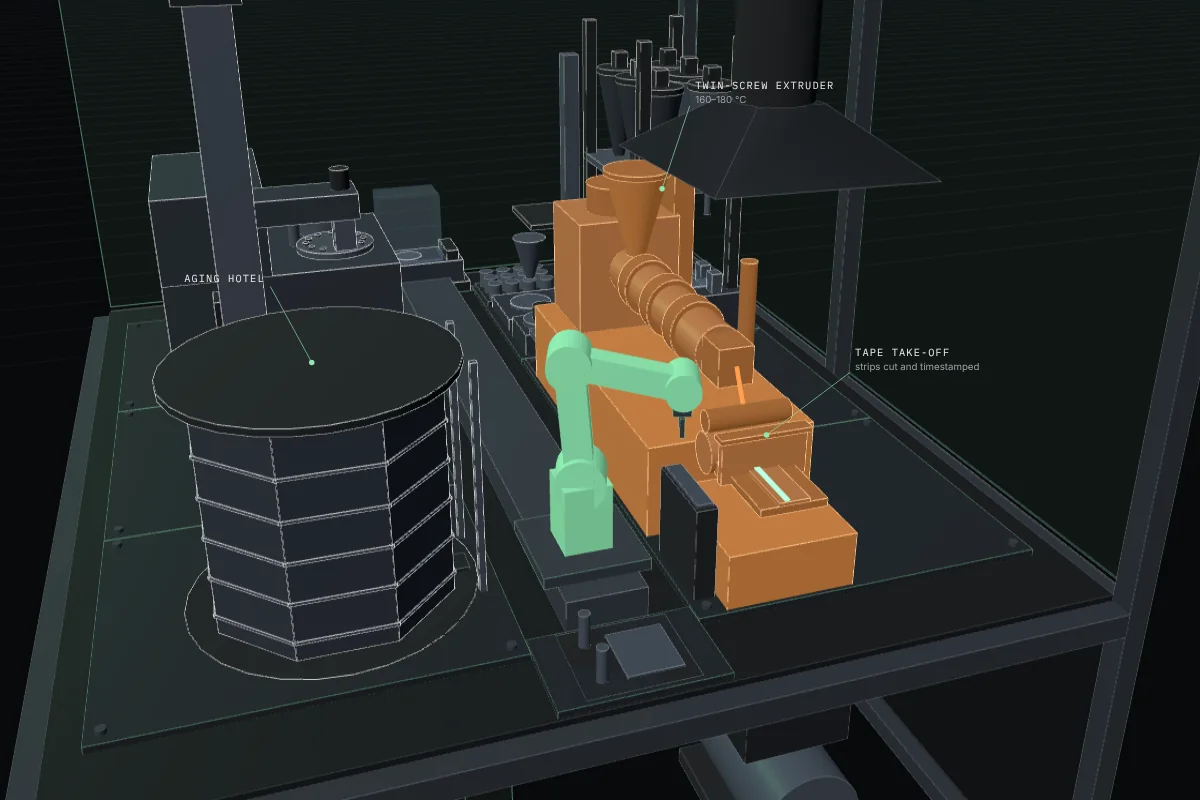 Concept render · planned system
Compostable polyesters — the brittleness problem
PHA is a family of bio-based, compostable plastics that could replace single-use petroleum plastics, but it turns brittle as it ages and is hard to process at industrial scale. The first module is designed to take resin bought from suppliers and search formulations and process settings for blends that stay tough at viable unit cost.
PHA keeps crystallising after it is formed, so a part that passes on day one can fail a week later. In the planned workflow each formulation is weighed out, melt-mixed, cast into tape and cut into test strips. The strips are pulled at 2 hours, 24 hours and 7 days, and a thermal scan measures how crystalline the material has become.
It suits the loop: the feedstock can be bought, the failure mode can be measured, and the space of additives and process settings is far larger than a manual programme can cover.
Fungal biomaterials — three-day growth cycles
Three-day growth cycles make fungal biomaterials a strong test case for rapid, continuous iteration. Where a conventional programme might see a handful of generations in a quarter, the loop works through dozens.
Short cycles change what is worth trying. When a result comes back in days rather than months, exploratory experiments stop being expensive, and the system can afford to test directions a human programme would never budget for.
Growth is also richly measurable. Density, rate, morphology and substrate response all give continuous signal rather than a single end-point reading, which is exactly the kind of data the model needs to improve.
Geothermal silica byproducts — advanced ceramics
Silica byproducts from geothermal energy plants are being developed into advanced ceramic materials, turning an industrial waste stream into feedstock.
The input is abundant, inexpensive and already produced at scale — an unusually good match for a system whose advantage depends on running a very large number of physical experiments.
It also sits in a different regime from the two bio pilots entirely: inorganic, high-temperature, structurally measured. Running it on the same base cell is how we show the infrastructure is general rather than tuned to a single substrate.
AI models are running out of original, high-quality data about how the physical world actually behaves.
The materials sector needs faster and cheaper paths to discovery than it has today. LLMs can process information at a scale that remains largely untapped by the manufacturing sector.
Exper addresses both needs from the same infrastructure.
Licensing, data partnerships, or a conversation about what the system could run next.